Troubleshooting
Every single hypnotist, at some point, will give a suggestion that produces unexpected results. In some cases, these can be abreactions, unexpected physical reactions, or overreactions. These are mostly covered in the Risks section. In other cases, either nothing happens (or appears to happen), or the hypnotee does not respond to the suggestion in the way that the hypnotist wanted. This page is about working from that point — the suggestions that don’t work, the "difficult" and "analytical" subjects, and determining when things aren’t in sync.
Troubleshooting is by nature an individual activity, but we can break it up into broad sections:
-
Identification
-
Feedback
-
Adjustment
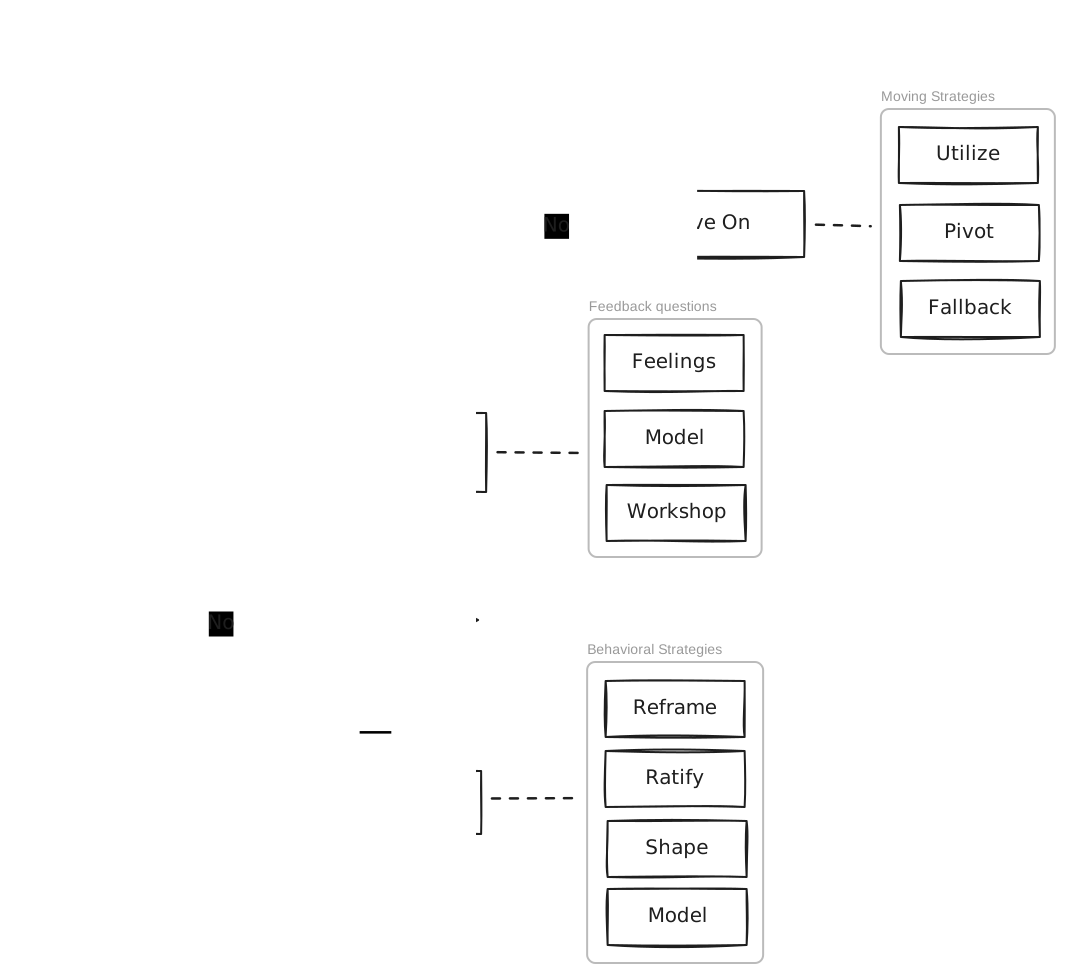
Here’s a flowchart diagram.
Identification
The first part is seeing that something happened.
This can be surprisingly difficult, especially in non-verbal actions that don’t involve movement. Your partner may be holding a position that is uncomfortable for them, may have a cramp, may need to use the bathroom unexpectedly, or may have hit an emotional wall unexpectedly. If you have constrained their movement or their ability to communicate, they may feel obliged to "hold on" even when holding on could make it worse.
If you see that your partner isn’t looking great, you can tell them to check in and flip it into a situation where they are required to tell you what’s up.
A more common case is where you give your partner a suggestion and they don’t or can’t follow it. You tell them their hand will rise by itself, and the hand doesn’t rise. You tell them to forget a number and they still know it. You tell them to imagine a scenario, and they can’t quite get their head around it. You tell them to hallucinate and they say they don’t see anything.
Often, you’ll find that you’ll have done something wrong, usually in missing a step. This rant provides a helpful list of questions you can ask yourself.
There’s three questions to always ask when a suggestion isn’t working:
-
Did I setup the suggestion for success?
-
Is my partner in the right headspace for the suggestion to work?
-
Am I in the right headspace to give the suggestion?
Setup For Success
Setting up the suggestion for success involves laying down the groundwork and working up to the suggestion first.
Some setup is universal. You negotiated consent, you discussed the suggestion during a pretalk, you built rapport, you explored experiences rather than giving pass/fail tests, and you used pyramiding to work from ideomotor effects to perception. The more steps you skip, the more likely you are to get unexpected behavior.
Some setup for a suggestion is setting the scene appropriately. If you are doing a tropey and slightly humiliating suggestion like having your partner clucking like a chicken, you’re going to want to tailor the induction for stage hypnosis and walk your partner through interesting suggestions that focus on performing physical actions.
Some people can have problems with goal directed fantasies ("imagine a balloon lifting your arm") vs direct instructions ("imagine that arm lifting by itself"). If your partner has trouble visualizing a particular suggestion, try removing the fantasy and only giving the instruction.
Avoid suggestions that surprise or shock your partner. Your partner should have an expectation that the suggestion is coming, and be ready for it. Ignore any advice to do with instant inductions, transderivational search and the like — no matter how shocking the suggestion appears, the hypnotee had either gone through a pretalk or had previous experience that had primed a response to the suggestion. One useful tip: If you have a suggestion that requires some build up, you can ask them to imagine following the suggestion as a way of planting a seed.
Some suggestions, especially those requiring emotional or physical release, need your partner to be holding some tension. If your partner is completely relaxed and limp, they will have a hard time jumping from one state to another. See tension and release section of the guidelines.
If you and your partner have good rapport and you have gone through set up, then your partner might just be confused about the suggestion itself. This might be an issue with the suggestion itself, or it might be because you have made assumptions about your suggestion that doesn’t match with your partner. For example, you assume that an idea or situation is associated with a particular set of feelings, and their associations are quite different. For example, you might be an extravert and think the idea of a party is exciting, while your partner is an introvert and views parties with dread.
This misunderstanding can often be a cause of confusion with neurodiversity, often called the double empathy problem. If your partner is neurodivergent, you may want to adjust your suggestions to account for how they process information. See the Autism and ADHD pages for examples of how to work with neurodiversity. You may also be neurodivergent working with a neurotypical partner. Here, you’ll need to think like your partner and think about your partner’s background and assumptions to bridge the gap.
Partner’s Headspace
Even if your partner is not confused about the suggestion itself, they may need time to get themselves into the right headspace to follow the suggestion. A big part of the ritual of hypnosis is setting the scene appropriately and warm up to the point where your partner is willing and eager to follow the suggestion. If you can’t tell where your partner is mentally or emotionally, check in and ask using clean language. Be aware of your partner’s energy.
Your partner’s response also depends on their interpretation of you. If the suggestion itself doesn’t match up to their perception of you (aggressive when you’ve been friendly, using rougher language, or abrupt) or worse, it brings up unpleasant past experiences, then your partner may not follow the suggestion because it has shaken the rapport.
Your Headspace
Finally, and most importantly, you have to ask yourself if you were in the right headspace when you gave the suggestion. Even in a deep trance, your partner can sense your energy and intent.
If you are emotionally dysregulated and not centered and grounded in yourself, then you can end up in a situation where the words don’t match the music — you followed all the steps correctly, the suggestion has worked before, your partner is willing, but the way you gave the suggestion is off enough that it triggers a red flag to your partner. This can show up in your phrasing, your emphasis, or your body language.
This can be the most challenging identification to make. Your partner may not consciously know why they didn’t follow the suggestion, and the disruption of not following the suggestion is dysregulating in itself. If you are neurodivergent and have alexithymia, you may not even realize how you are presenting to your partner. And hardest of all, no-one wants to think of themselves as being perceived as a threat.
Importance
The first decision to make is based on two factors: the importance of the suggestion, and your partner’s reaction.
If you’re in the middle of a flow and things are going well and your partner is not discomforted, you may just acknowledge it briefly and move on. This is also practical if you are testing until failure, and your partner is just expected to put their best effort in. You always have the option of discussing it during debriefing afterwards.
There are various strategies for moving on with a suggestion that didn’t work:
Utilization
Whatever your partner did or didn’t do, you meant for that to happen. Works well with a "there is no failure, only feedback" approach. For example, if your partner is not raising their arm because it feels heavy, switch to the arm being so heavy that they just can’t move it.
Pivoting
Rather than switching out the suggestion, you can give a different suggestion with the same effect. For example, you can tell your partner to raise their arm in the air directly, and experience lightness as they raise it.
Anthony Galie demonstrates here using a fixation technique with one participant while giving deepener suggestions to the group as a whole:
Fallback
Fallback is simple: give them a suggestion that you know they can follow, because they’ve successfully done it before. The classic case is dropping someone into trance by telling them to sleep — your partner can immediately drop regardless of their suggestion, and you’ll have some breathing room.
Another variant of fallback is nesting suggestions, popularized by Hypnosis Without Trance. For example, you might start by sticking your partner’s feet to the floor. Then, rather than cancelling the stuck feet, you immediately move to an amnesia suggestion. When you close the amnesia suggestion, you can ask "how are your feet?" If any nested suggestion fails, you immediately fallback to reminding them of the suggestion in the outer loop, and continue on from there.
Feedback
If it’s a new suggestion that you are focusing on, or if your partner behaved oddly to the suggestion and you don’t want to move on, it’s time to shift your focus to getting addtional feedback.
There’s two parts to getting good feedback from your partner: how did they feel, and what did they think? Listen without judgement and avoid injecting your own viewpoint. Use clean language.
This is also a good point to consider whether you want to continue with the session or stop and call a timeout. If it’s not working, it may be for bigger reasons than you can address in session, and there’s no harm in taking a break.
Feelings
Ask about your partner’s internal experience when given the suggestion, and how they reacted. Listen for points of conflict. Did they feel like they were forcing, fighting, or faking anything? Was there a part of them that felt unwilling or felt the suggestion was implausible?
Your partner may have feelings about the suggestion. In some cases, they might be upset, either at you or at themselves for their reaction or lack of it. Work this out first before you do anything else. It’s important to keep your partner’s morale up, and this may be a reason to move on rather than focus on it.
It is important to be kind and accepting of your partner’s feelings. Your partner, of course, may also want to timeout or halt the session, and of course has the final say in whether or not they want to continue.
Understanding
The way that you phrased the suggestion may be ignoring or work against your partner’s internal context, or your partner may not have any mental model of how it should work.
Misunderstandings are surprisingly common. Your partner might think they followed the suggestion exactly as you phrased it, even though you might have had something else in mind.
Another possibility is that your partner may simply not understand what you meant, or your suggestion may work at cross-purposes with another suggestion.
Workshop
You can ask your partner if they would phrase the suggestion differently, or have an idea of how to implement it. Workshopping with your partner can help here, but you have know when to let it go. Keep it moving and keep your partner engaged in following suggestions. It’s better to try several different things in succession, rather than getting bogged down with an interview.
Adjustments
Reframe
Reframing is about taking what already exists, and utilizing it.
Take what your partner has given you in their feedback. Validate their response and feelings, and reframe your suggestion in their terms and in their language. This is one area that Erickson really excelled — roll with your partner’s beliefs and leverage them if you can.
The appropriate suggestion is the one that fits best for how your partner tends to think. If your partner is technical, they might like a mechanistic explaination. If your partner is very sensory, ask them to remember sensory experiences they’ve had that might be similar. Focus on what your partner can do, and what they’re good at.
Your partner may have a narrative or story associated with themselves that you can leverage for the suggestion. Use hypnosis as story and use your partner’s aspirational stories and fantasies as fuel. By following the suggestion, they can be the person they imagine.
This also applies to the framing of hypnosis itself. Frame hypnosis as a skill that develops with practice, not a binary pass/fail test. Emphasize that:
-
Small wins accumulate into bigger capabilities
-
Consistent practice matters more than perfect responses
-
Each attempt gives useful information, even partial responses
-
Hypnotic ability grows over time with experience
This reframes "failure" as "data collection" and reduces performance anxiety that can block responses.
Ratify
Someone who approaches hypnosis in a particular style or as part of a particular induction may find it easier to follow suggestions when things are most familiar.
If your partner is most familiar with following suggestions in a deep trance or a fractionation induction, set the scene to one that is most appropriate for that suggestion.
Use analog phenomena over binary pass/fail tests. If your arm raises, that’s a response. If your hand feels light, that’s a response.
Shape
Sometimes a suggestion doesn’t work because your partner hasn’t built up the necessary responses yet. Rather than trying harder at the same thing, you can use behavioral shaping to build toward the desired response through smaller, achievable steps.
Break down the target suggestion into smaller components and work through them progressively. Each successful step builds evidence and expectancy for the next one.
For example, if arm catalepsy isn’t working:
-
Start with just noticing tension in the arm
-
Then make the arm feel stiff at the elbow
-
Then extend stiffness to the whole arm
-
Finally, suggest the arm locks completely rigid
Each step ratifies the previous one and builds momentum toward the target. Recognize and reward the small steps, and don’t be afraid to pause it and come back to it later in another session.
Model
Modelling is about introducing new ideas that didn’t already exist.
Sometimes, your partner may not have a mental model or story that works for them and their language and feedback is fragmented. If your partner doesn’t have any kind of model or story, you can provide your own, or use a "well known" model, whether that’s science, NLP, or well-known trope. I make a distinction between reframing vs modeling here as reframing doesn’t present any new information, whereas modelling can involve some amount of new information to assimulate — this means that modelling does require your partner to be alert and focused enough to absorb what you’re saying.
For a science based approach, help your partner understand how their brain already does what you’re suggesting. The brain fills in blind spots, filters sensory information, shifts attention, and constructs experience constantly. Hypnotic suggestions work with these existing processes, not against them.
If your partner is having trouble with a visual hallucination, you might explain: "Your brain is constantly constructing what you see. Right now, it’s filling in your blind spot without you noticing. You’re filtering out background noise. We’re just directing that same process toward something specific." Leverage the sensory page to explain how they can alter what they see outside of hypnosis.
You can also tell your partner stories and anecdotes that tie into the suggestion — Erickson used this technique extensively. For darker patterns, you can use NLP bullshit, gaslighting or straight out lying. Delusioness has a useful guide to possible strategies, with a NSFW followup.