Cold Control
In the end, we are self-perceiving, self-inventing, locked-in mirages that are little miracles of self-reference.
I Am a Strange Loop
Cold Control Theory (CCT) is a recent (2007) theory by Zoltán Dienes and Josef Perner in Executive Control Without Conscious Awareness: The Cold Control Theory of Hypnosis.
I’ve put CCT on its own page because unlike the Components of Hypnosis page, there’s really nothing that you can use directly from CCT in your practice. If you’re here and still interested, know that it’s purely for the love of the game.
Vreahli has a page on Higher Order Thought and another on Cold Control specifically, and I recommend checking them out.
The Theory
CCT is built on David Rosenthal’s Higher-Order Thought (HOT) theory of consciousness. In HOT, a thought or mental state is conscious when there is a "higher order thought" about being in that state.. There are various levels of higher order thoughts, including second order and third order thoughts, but the important distinction is that there is an unbroken chain between higher order thoughts and the first order thought, also known as the intention.
So, in normal thought, there’s an unbroken line between conscious awareness and the unconscious intention to raise the arm.
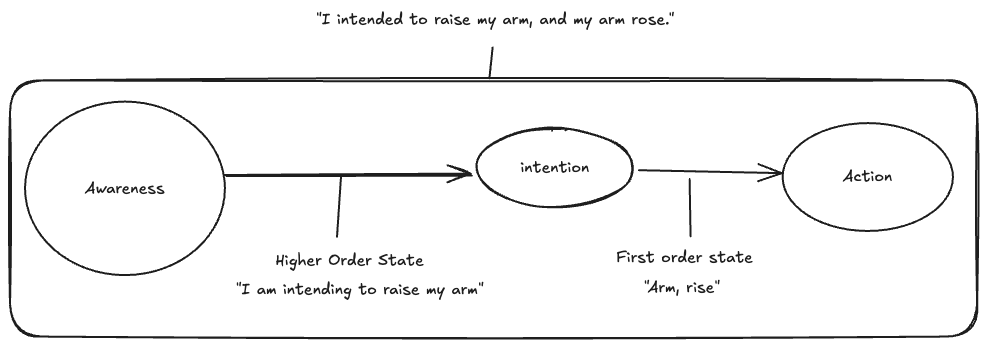
In hypnosis, CCT posits that this connection is broken because the higher order thought either does not exist, or is suppressed or inhibited in some way.
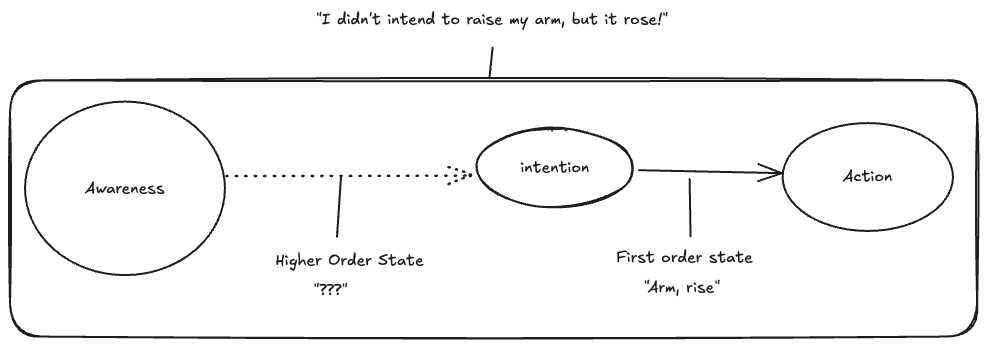
This lack of intentionality is considered important enough in hypnosis that it’s called the "classic suggestion effect" and CCT attributes it to a lack of metacognitive awareness.
CCT also uses HOT to explain amnesia and hallucination. Amnesia is straightforward — the suggestion to forget the number "4" involves executive control over counting, but the subject will deny any such conscious awareness. Hallucination, especially positive hallucination, is a little more complicated. In CCT, a positive hallucination is an intention to imagine seeing something, and then an inaccurate second order thought so that instead of correctly recognizing the intention as mental imagery, it is recognized as a visual perception.
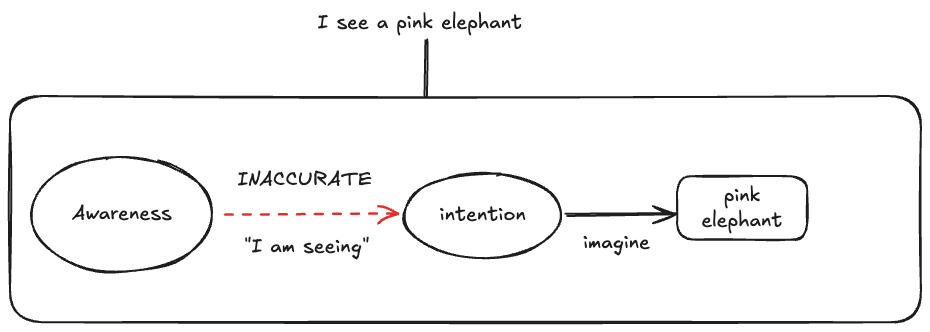
Hallucinations are recognized as more difficult for people, and the paper provides two reasons for this: it’s a deeper suppression, and it requires a high first order effort — generating a vivid mental image and simultaneously tweaking the higher order thought so it is perceived as reality is complicated for most people.
HOT has a lot in common with Barrett’s theory of constructed emotion, in that a HOT is a construction on top of more basic inputs. Ledoux’s A Higher-Order Theory of Emotional Consciousness is the bridging paper here, with Barrett using prediction as a model and LeDoux depending on working memory. To me, imagining perceptual consciousness as a continual process of construction feels more intuitively natural, but ultimately it’s a difference in perspective on the same activity: creating story and narrative out of the raw data.
Positive Predictions
CCT makes a number of predictions, some of them confirmed, some of them not.
Confirmed
Starting with the confirmed ones:
-
High hypnotizables should respond to suggestions just as well with contradictory imagery as consistent imagery, because highs can suppress SOTs (section 16.4.3.1). This was confirmed in Cognitive Competition and Hypnotic Behavior: Whither Absorption? and Does counterpain imagery mediate hypnotic analgesia?
-
Highs should produce analgesia equally in and out of hypnotic context (section 16.4.3.1). This was confirmed in Hypnotic Analgesia and Stress Inoculation Training and The effects of hypnotic and nonhypnotic imaginative suggestion on pain.
Partially Confirmed
There’s a result that is partially supported:
-
Hypnotic hallucinations should activate visual cortex, because cold control works via imagination, not empty HOTs (section 16.5.1). This was partially supported by Hypnotic Visual Illusion Alters Color Processing in the Brain.
Not Confirmed
And finally there are some unconfirmed predictions:
-
rTMS applied to frontal areas should reduce hypnotic response, especially for executive suggestions like selective amnesia (section 16.4.5).
-
Frontal lobe patients should have low hypnotizability scores (section 16.4.5).
-
Effort ratings for tasks outside hypnosis should correlate with the difficulty of corresponding hypnotic suggestions (section 16.4.3.2).
The rTMS prediction was also later revised by Dienes himself. Lau and Passingham (2006) identified the left mid-DLPFC as the specific region constructing accurate HOTs, and Rounis et al. (2010) showed rTMS to that area disrupts metacognitive awareness without affecting first-order performance. In Is hypnotic responding the strategic relinquishment of metacognition? (Dienes, 2012), the prediction was inverted: disrupting DLPFC makes it harder to be aware of intending, so it should be easier to respond to suggestions. This revised prediction was confirmed in Understanding hypnosis metacognitively: rTMS applied to left DLPFC increases hypnotic suggestibility. A conceptual replication using alcohol (which also disrupts frontal function) produced the same result: medium-susceptibility participants who consumed alcohol were significantly more responsive to hypnotic suggestions than those in a placebo condition, reported in Alcohol increases hypnotic susceptibility.
This implies that frontal lobe patients with damage localized to HOT-construction regions should be more suggestible, while patients with broader executive damage may be less. I’ve not found anything specifically on hypnosis, but Domain-specific impairment in metacognitive accuracy following anterior prefrontal lesions does indicate impaired metacognitive accuracy without impaired first-order performance.
Negative Predictions
There is a follow up paper: Phenomenological control as cold control. The title is somewhat inaccurate, as it does not prove that phenomenological control is cold control; instead, this paper is a stress test: it attempts to find various things that should not be possible if Cold Control Theory is true.
The problem with negative predictions is that they are very hard to prove. If there were a positive counterexample, it could disprove it, but every negative result only fails to refute it. This means that a theory based on negative results is effectively unfalsifiable in practice.
No Superpowers
If the only effect of hypnosis is inaccurate or missing HOTs, then hypnotic superpowers are not possible (sections 16.4.2,16.5.1).
The big one is the word blindness effect, where highly hypnotizable people use suggestion to drastically reduce the Stroop interference effect. The paper describes CCT as having "escaped refutation" but mentions an ongoing study by Palfi et al. The completed study is Can unconscious intentions be more effective than conscious intentions? and it says:
Both the suggestion and the request reduced Stroop interference. Crucially, there was Bayesian evidence that the reduction in Stroop interference was the same between the suggestion and the volitional request. That is, the results support the claim that responding hypnotically does not grant a person greater first order abilities than they have nonhypnotically, consistent with cold control theory.
There are other automatic cognitive processes like the Flanker task and the McGurk effect that are also rebutted. There’s also a test for synesthesia that concludes hypnosis does not magically enhance ability.
Timing
Imagine an experiment: A participant presses a button. 250ms later, a tone plays. On separate trials, they’re asked to estimate when the button press happened, and when the tone happened.
There’s an effect called "intentional binding" where the brain pulls together the perceived times of cause and effect. You think you pressed the button later than you did (action binding), and the tone happened earlier than it did (outcome binding). This only happens when you push the button — if someone else moves your finger for you, the effect doesn’t happen. As such, this experiment has been used as an implicit measure of sense of agency.
The precision of action timing changes how these interact: imprecise action timing produces stronger action binding, and precise action time produces stronger outcome binding.
CCT predicts that unconscious intentions should produce measurable differences in intentional binding (more action binding, less outcome binding). The paper supports this with two studies, Intentional binding as Bayesian cue combination and The Power of Suggestion: Posthypnotically Induced Changes in the Temporal Binding of Intentional Action Outcomes, but some components were inconclusive.
Mindfulness
Mindfulness, defined as acting with awareness, is determined to be roughly the opposite of cold control, as in principle hypnotic response requires being unaware of a specific intention.
The paper cites Demand characteristics confound the rubber hand illusion.
We estimated the slope for acting with awareness as a decrease of 0.13 rating units of subjective score for SWASH (on a 0-5 Likert scale) for a one Likert unit change in AA (95% CI [.02, .24]; r -0.12). This negative relation is consistent with the claim that one way of being high in phenomenological control is by being habitually low in awareness of intentions[.]
Although they do admit it’s almost impossible to test as the predicted effect is tiny:
Indeed, based on the error variance in these data we can estimate we would need about 3,000 participants in total to have a 50% chance of getting good evidence for an effect should there be one of the size anticipated. Although we did not obtain good evidence one way or another, we have learned that looking for a change in mindfulness causally changing hypnotic response will need a massive effort, only available to those who use institutions such as, for example, the psychological accelerator (https:// psysciacc.org/). The correlational evidence, however, reveals a small and negative relation between the relevant mindfulness facet and hypnotic responsiveness. Thus, cold control theory has successfully pointed to which aspect of mindfulness is potentially negatively related to hypnotic response.
Criticisms of HOT
A good overall summary of objections to the higher order approach is at the Stanford Encyclopedia of Philosophy. These are primarily philosophically based arguments, so I’ll just pick one out to give you the idea.
Ned Block argues The higher order approach to consciousness is defunct. His argument is the empty HOT problem: you can technically have a HOT without an actual first order state. HOT has two conditions — a sufficient condition, and a necessary condition. According to HOT’s sufficient condition, that HOT alone should be enough to produce a conscious experience. But according to HOT’s necessary condition, any conscious episode must itself be the object of a HOT. These can’t both be true.
Suppose that at time t, I have an assertoric higher order thought to the effect that I am experiencing seeing something green, but in fact I am having no visual representation at t: the thought is 'empty'… The sufficient condition dictates that this thought at t is sufficient for a conscious episode at t. By the necessary condition, that conscious episode at t is the object of a simultaneous higher order thought. In the example, there is only one higher order thought at t… So there is no conscious episode at t after all. Thus, the sufficient condition and the necessary condition are incompatible.
Block also says that HOTs don’t matter if they aren’t connected to anything:
To be 'worth anything', a theory of consciousness 'must be about consciousness in a sense that matters to us in the way that conscious agony or ecstasy matters'… 'If a state of being conscious of agony is supposed to matter equally whether [the agony] exists or not, the supposed theory of consciousness is worthless.'
Rosenthal’s reply is that a theory of consciousness explains subjective appearance, not underlying mental reality. A HOT is sufficient for a state to seem to occur in one’s stream of consciousness — not for the first-order state to actually exist. Conscious agony in the empty HOT case is real as a subjective appearance; whether there’s actual agony underneath is a separate question.
What counts for somebody’s being in a conscious state is just the occurrence in one’s stream of consciousness of the relevant subjective appearance, the appearance of being in the state in question. A theory of consciousness explains conscious subjectivity, not the underlying mental reality that’s responsible for these appearances.
The conversation between Block and Rosenthal continues, if you’re into that. For what it’s worth, Cold Control Theory explicitly rejects empty HOTs (section 16.5.1).
But this still doesn’t really ground HOT in anything. What does it actually mean, in practice, to have a higher order thought?
Empirical Evidence for HOT
HOT occupies an interesting position, as it’s a theory based on philosophy that intentionally does not map to neurons. In Two concepts of consciousness, Rosenthal says:
By itself, the present account of consciousness does not imply a materialist or naturalist theory of mind. Indeed, the account is compatible with even a thoroughgoing Cartesian dualism of substances. But it does square nicely with materialist views. For the account holds that what makes conscious mental states conscious is their causing higher-order thoughts that one is in those mental states. And the materialist can reasonably maintain that this causal pattern is due to suitable neural connections.
As such, the work of providing a view of HOT through cognitive neuroscience falls to others. This is… awkward. Technically, any architecture that supports a "higher-order representation" qualifies, and so HOT’s predictions at the neural level are too broad to be falsifiable.
Lau in Empirical support for higher-order theories of conscious awareness says "this interpretation is accepted by many authors [2,6] including first-order theorists [12,13]" but when you look closer at the citations, it’s a self-citation, Kriegel (a philosopher), and Block (also a philosopher, who accepts the prefrontal interpretation but is arguing against HOT). Looking at the actual neuroscience citations in the paper, it’s Relative blindsight in normal observers and the neural correlate of visual consciousness (Lau again), Experimental and theoretical approaches to conscious processing (GWT, not HOT), Neural correlates of consciousness in humans (theory neutral), and Pattern of neuronal activity associated with conscious and unconscious processing of visual signals (also theory neutral).
Of these, the Blindsight paper is the most important. Using visual masking, they created conditions where subjects' ability to discriminate between two figures stayed the same, but subjects reported being consciously aware more frequently in one condition than the other. The higher awareness was associated with dorsolateral prefrontal cortex activity and not early visual areas.
Other Theories
The higher awareness is an important result, because it directly distinguishes HOT from first-order theories, of which there are many.
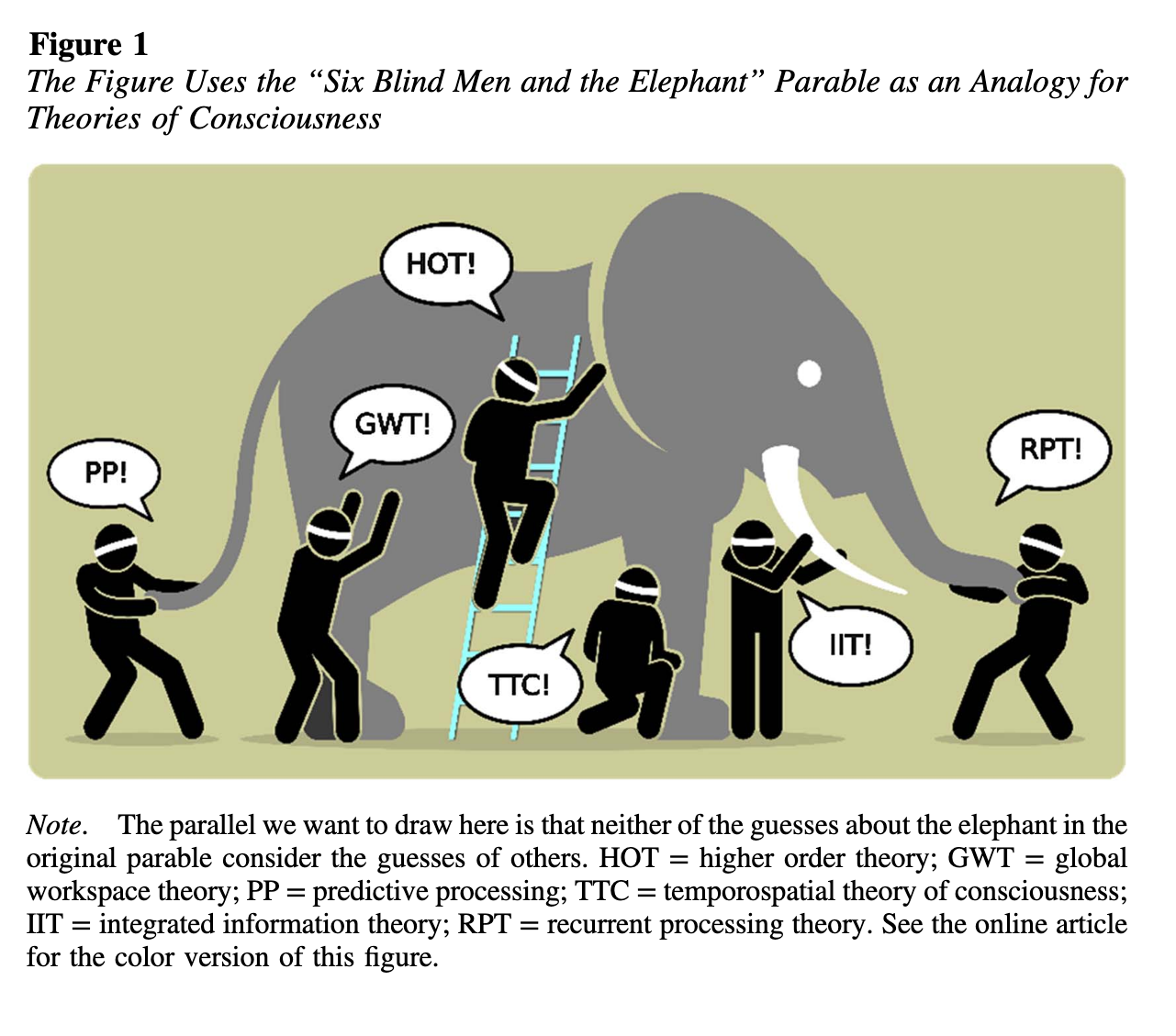
In fact, part of the problem with theories of consciousness is that there are so many of them. Worse, the theories do not agree with each other, to the point that after a public debate, the conclusion was "here is currently significantly more disagreement than agreement between the theories."
The first order theories:
-
Dretske’s Naturalizing the Mind
-
Block’s Phenomenal Consciousness
-
Lamme’s Recurrent Processing Theory
-
Zeki’s Disunity of Consciousness
However, the blindsight result doesn’t distinguish HOT from the other higher order competitors, for example:
-
Higher-Order Perception Theory
-
Same-Order Theory (Self-Representationalism)
-
Dispositional Higher-Order Thought Theory
-
Higher-Order Statistical Inference View (Lau’s own higher order theory)
-
Radical Plasticity Thesis
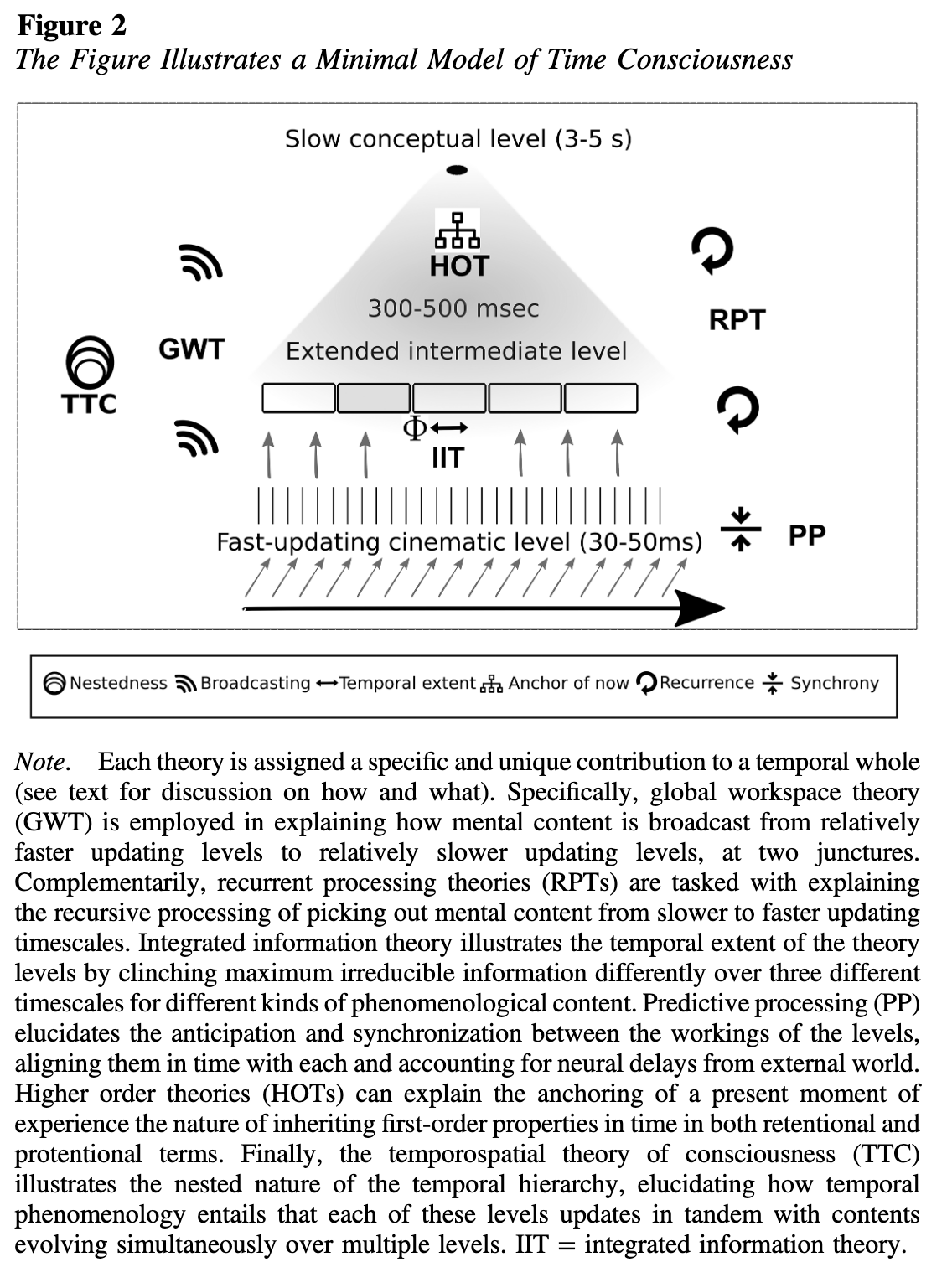
In addition to the above, there’s also Global Workspace Theory (GWT) and Information Integration Theory (IIT), which are not higher order theories but are frequently cited. And then, finally, there’s predictive processing and active inference.
In fact, there are so many theories that there are theories on integrating the theories. From Just one moment: Unifying theories of consciousness based on a phenomenological “now” and temporal hierarchy there are two diagrams that say everything about how the theories interact, arguing that any or all of them could be correct.
Mechanistic Explainations of HOT
But back to the HOT implementation. What actually is a higher order thought?
To Lau, it’s a higher order representation. This is a subtle shift, because you can’t measure a thought but you can measure a representation. This feeds into Lau’s Higher-order statistical inference view theory, which makes it a little confusing as to whether Lau is advocating for HOT or his own theory.
Lau’s theory is fully explained in A higher order Bayesian decision theory of consciousness. Instead of a thought, there’s a Bayesian decision process: consciousness arises when the DLPFC correctly sets a criterion based on learned higher-order representations of internal signal statistics.
The learning of one’s own internal signal produces representations concerning the internal signal, which itself is a representation of the external stimuli. In this sense, we are creating representations of representations, and thus they are described as 'higher-order' representations (Rosenthal, 2000, 2002).
The idea of higher order neurons is uncontroversial, and I think is almost a prerequisite for any complex neural network. Going down to a lower level, there are neurons which specifically light up at a metacognitive level, much like how there’s a neuron that lights up every time you think of Bill Clinton, or how you can tweak the Golden Gate Bridge neuron in a large language model.
Importantly for hypnosis, Lau’s theory is organized around the concept of dissociation and signal detection theory, using detection sensitivity (d') and the criterion for detection (c). When there’s a disconnect between the objective performance (d') and the reported consciousness (c), there’s dissociation.
One basic prediction of this framework is the dissociation between consciousness and detection/discrimination performance… consciousness depends on the representation of the probability distributions… This representation may err. Therefore the framework predicts that given the same d', the same subjects performing the same detection/discrimination task may report different levels of consciousness under different conditions.
He identifies three distinct forms of dissociation, each caused by a different failure mode of higher-order representation:
-
Misrepresentation: the criteron is set too high despite the signal being detectable. This is blindsight, where nothing reaches consciousness.
-
Ambiguity: the higher order representation has wide error bars. The input doesn’t change, but it’s not clear what is being seen.
-
Dynamic fluctuation: the higher order representation’s learned model keeps changing, making it impossible to meet the criterion.
Lau’s framework is specifically about perceptual consciousness (criterion-setting for detecting external stimuli), and he doesn’t extend it to agentive consciousness (awareness of one’s own intentions), so it technically doesn’t bridge the gap to Cold Control Theory. Nevertheless, this is as close as I can get to grounding Cold Control Theory down to the neuron level, so I’ll take it.
(Lau’s isn’t the only mechanistic HOT theory. There are other theories even at the HOT level: Higher Order Syntactic Thought and Fleming’s perceptual reality monitoring described in Awareness as inference in a higher-order state space, but as I’m still working my way through them, I’m sticking with Lau as an example.)
Summary
CCT offers a coherent account of hypnotic phenomena grounded in Rosenthal’s HOT framework. The core insight is reasonable, philosophically defensible, and generates testable predictions.
But… there’s not a lot that points to CCT specifically as The One True Answer. There’s a large overlap between the predictions CCT and Integrative Theory, for example: they both argue for no special trance state, no superpowers, reduced metacognitive awareness, harder hallucinations. The only way I can think of to distinguish them is to test frontal lobe patients for hypnotizability: integrative theory predicts as long as they have expectancies and response sets they should be normal, CCT predicts they should score low.
The neural evidence for higher order processing is real and well established, but again, there are many theories of consciousness to choose from amidst increasing friction between philosophers and scientists. Rosenthal’s reframing of HOT as a theory of subjective appearance doesn’t help, and HOT technically doesn’t even have a horse in the race if you count Lau’s theory as distinct from Rosenthal’s theory.
CCT does not connect its HOT suppression mechanism to specific neural circuitry, though Lau’s Bayesian account gestures toward DLPFC. Lynn’s integrative theory invokes Friston’s predictive coding as a framework for expectancy updating, but applies it at the cognitive level rather than providing a more concrete neural account of hypnotic dissociation.
That being said, Lau’s Bayesian framework gets closest to a mechanistic account of HOT: consciousness as criterion-setting based on learned higher-order representations of internal signal statistics, localized to the DLPFC. This grounds the dissociation between objective performance and subjective awareness in concrete neural terms. But the framework addresses perceptual consciousness and has not been extended to agentive consciousness, which is what CCT specifically requires.
Unfortunately, there are limitations on the tools available. By some accounts, neuroscience is pre-paradigmatic and would fail at understanding a microprocessor using the current tools. Until we get to put genetically engineered mice genes into humans so we can watch neurons light up, human cognitive processing and perceptual monitoring is a black box. I suspect that as dissociation is the defining characteristic of hypnosis, exploring dissociation in hypnotic vs non-hypnotic contexts might tell us more about the underlying mechanism, but for now I think if CCT can be connected to Lau’s mechanistic implementation, this is as good as it gets.